The Meta Verdict and Google Verdict
A Los Angeles jury just handed Meta and Google a defeat that goes far beyond the $6 million price tag. Here’s why the Meta verdict and Google verdict in the social media addiction trial may force a complete overhaul of how these platforms operate — and what comes next.

On March 25, 2026, a Los Angeles jury delivered what many are calling the most consequential tech ruling since the 1990s tobacco lawsuits. After nine days of deliberation and a seven-week trial, jurors found Meta (Instagram) and Google (YouTube) negligent for designing addictive platforms that harmed the mental health of young users. The ruling awarded $6 million in total damages — $3 million in compensatory damages and $3 million in punitive damages — to a 20-year-old plaintiff identified only as K.G.M.
The Meta verdict carries 70% of the liability. The Google verdict assigns the remaining 30%. Both companies have announced plans to appeal.
But the dollar figure is almost irrelevant. Meta pulled in roughly $201 billion in annual revenue in 2025, according to its fourth quarter earnings report. Alphabet (Google’s parent company) surpassed $402 billion in annual revenue that same year, per MacroTrends financial data. A $6 million verdict against companies generating over $600 billion a year combined barely registers as a rounding error.
What does register is the legal precedent — and the roughly 2,000 pending lawsuits waiting to follow.
What the Meta Verdict and Google Verdict Actually Proved
The significance of this ruling lies in how the case was argued and won. The plaintiff’s legal team deliberately avoided challenging the content on Instagram and YouTube, which would have run into the protections of Section 230 — the federal law that shields tech companies from liability for what users post on their platforms. Instead, the legal strategy targeted the design of the platforms themselves.
The jury concluded that Instagram and YouTube were deliberately built to be addictive, and that executives at both companies knew this and failed to protect their youngest users. Features like infinite scroll, algorithmic recommendation engines, and variable reward systems — techniques the plaintiff’s attorneys argued were borrowed from the gambling industry — were central to the case. As The Conversation reported, the plaintiff alleged the companies employed behavioral and neurobiological techniques similar to those used by poker machines and exploited by the cigarette industry to maximize youth engagement.
Internal Meta documents presented during the trial revealed damaging corporate knowledge. One document urged the company to bring in users as young as possible, while another showed that 11-year-olds were significantly more likely to remain on Instagram than switch to competing platforms. Meta CEO Mark Zuckerberg took the witness stand himself, testifying that user safety has always been a company priority, per NPR’s trial coverage.
The jurors weren’t convinced.

$375 Million in New Mexico: The One-Two Punch
The Los Angeles Meta verdict didn’t arrive in a vacuum. Just one day earlier, on March 24, a separate jury in Santa Fe, New Mexico, ordered Meta to pay $375 million after finding the company violated state consumer protection laws and enabled child sexual exploitation on its platforms. That case, brought by New Mexico Attorney General Raúl Torrez, stemmed from a 2023 undercover operation in which investigators created a fake profile of a 13-year-old girl that was quickly targeted by predators.
According to CNBC’s coverage of the New Mexico verdict, jurors found thousands of individual violations and imposed the maximum penalty of $5,000 per violation. While the $375 million total was less than the roughly $2.1 billion prosecutors sought, it represented the first time a state prevailed at trial against a major tech company over claims of harming children.
The New Mexico case isn’t over, either. A second phase of the trial begins May 4, 2026, when Judge Bryan Biedscheid will hold a bench trial to determine whether Meta created a “public nuisance” that harmed state residents’ health and safety. As Torrez told CNBC’s Squawk Box the day after the verdict, New Mexico will seek injunctive relief — meaning court-ordered changes to the design of Meta’s platforms, including real age verification, algorithm modifications, and an independent monitor to oversee implementation.
Will the Meta Verdict and Google Verdict Force a Platform Redesign?
This is the question that matters most. The financial penalties from these individual cases are survivable. What may not be survivable — at least for the current business model — are court-mandated design changes.
Several forces are converging. The New Mexico case’s May 2026 bench trial phase could result in a judge ordering Meta to redesign core features of its platforms. At the federal level, a multidistrict litigation (MDL 3047) overseen by Judge Yvonne Gonzalez Rogers in the Northern District of California has consolidated thousands of cases from parents, families, and over 250 school districts. A federal bellwether trial is scheduled for June 2026, featuring a Kentucky school district as the plaintiff, according to Bloomberg’s analysis.
Legal teams representing plaintiffs in those cases are specifically targeting design features they believe drive addiction: push notifications, autoplay, infinite scroll, and algorithmic feeds optimized for engagement over safety. As lead attorney Lexi Hazam told Bloomberg, the Los Angeles verdict has given her team significant momentum heading into the next round of trials.
The school districts are not just seeking monetary damages — they want changes to how these platforms operate. Any court orders that reduce the time users spend scrolling, sharing, and interacting could directly impact the advertising revenue that fuels both companies. Meta’s advertising business drove $58.14 billion in Q4 2025 revenue alone, according to financial reporting from the National CIO Review. YouTube crossed $60 billion in combined annual revenue from ads and subscriptions in 2025.
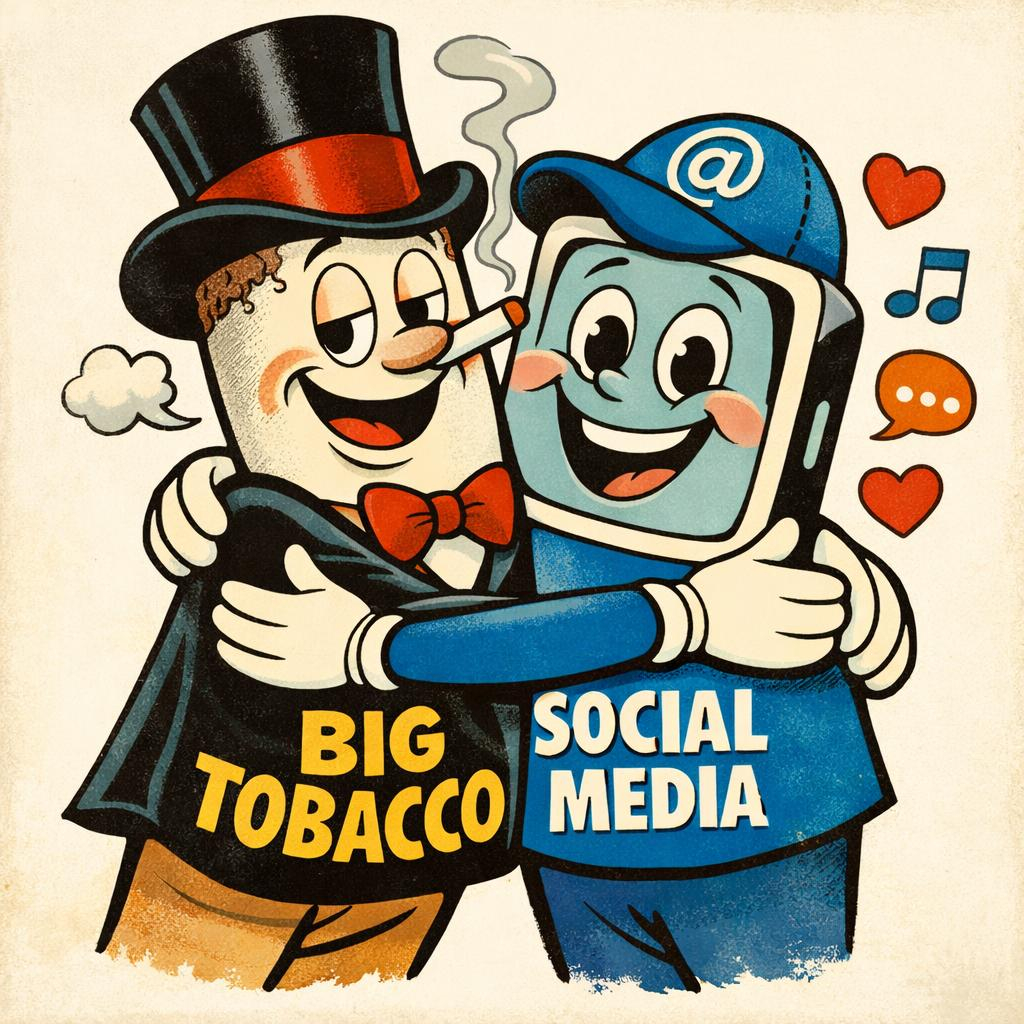
The “Big Tobacco” Comparison Is No Longer Hypothetical
Multiple legal experts, lawmakers, and advocacy groups are now openly comparing the Meta verdict and Google verdict to the landmark 1990s tobacco litigation that reshaped an entire industry.
The parallels are striking. In both cases, internal corporate documents revealed that executives understood the harmful effects of their products on users. In both cases, companies publicly denied those harms while privately leveraging them for profit. And in both cases, initial verdicts in early cases opened the floodgates for industry-wide legal accountability.
Democratic Senator Ed Markey was unambiguous, stating that the tech industry’s “Big Tobacco moment has arrived” and calling on Congress to impose real guardrails, as reported by CNN. Sarah Gardner, CEO of the Heat Initiative child safety advocacy group, told CNN that the verdict proves the harm was intentional and has now been established in court. Former FTC commissioner Alvaro Bedoya observed that a jury of ordinary citizens accomplished what Congress and state legislatures have not: holding these platforms accountable.
The 1998 Master Settlement Agreement with the tobacco industry resulted in over $206 billion in payments to more than 40 states and fundamentally transformed the industry’s marketing, product disclosure, and relationship with regulators, according to Insurance Business Magazine’s analysis of the verdict’s implications. Whether social media follows the same trajectory remains uncertain, but the legal infrastructure for that outcome is now firmly in place.
The Appeal and What Comes Next
Both Meta and Google have stated they intend to appeal the Los Angeles verdict. A Meta spokesperson said the company “respectfully disagrees with the verdict,” while Google’s José Castañeda argued that the case “misunderstands YouTube, which is a responsibly built streaming platform, not a social media site,” as reported by NBC News.
The appeals process will be lengthy and could ultimately reach the California Supreme Court or even the U.S. Supreme Court, where the boundaries of Section 230 protection may finally be tested at the highest level. But the appeals don’t freeze the broader litigation wave. Eight additional individual plaintiff cases are already scheduled for trial in Los Angeles this year. State attorneys general in roughly 30 states have active lawsuits against these companies. And the federal MDL trial this summer could produce binding precedents that apply nationwide.
Meanwhile, legislative pressure continues to mount. The Kids Online Safety Act (KOSA) has been circulating through Congress in various forms for years, and the verdict has given its proponents renewed ammunition. Republican Senator Marsha Blackburn urged Congress to enshrine protections for families into law following the verdict, per QuantoSei News. At the state level, Colorado is planning legislation in 2026 to require social media sites to implement parent-set privacy controls that children cannot disable. Australia has already banned social media use for anyone under 16.

The Bottom Line
The Meta verdict and Google verdict from March 25, 2026, are not about $6 million. They are about a legal theory — that social media platforms are defective products engineered for addiction — being validated by a jury for the first time. That validation opens the door for thousands of additional cases, potential court-ordered redesigns, and a fundamental shift in how the tech industry approaches engagement-driven design.
For parents, educators, and child safety advocates, this is a moment years in the making. For Meta and Google, the financial sting of this verdict is negligible. The reputational and regulatory consequences may not be.
The dam, as the plaintiff’s attorneys put it, is breaking.
Sources Referenced in This Article
- NPR — Meta and Google Found Negligent
- CNN — Social Media Addiction Trial Verdict
- NBC News — Meta and YouTube Negligent
- CNBC — New Mexico Meta Verdict
- CNBC — New Mexico Seeking Platform Changes
- Bloomberg — Big Tobacco-Like Fallout
- Fortune — Social Media’s Big Tobacco Moment
- CNN — Big Tobacco Moment Reaction
- The Conversation — Tech Law Expert Explains
- Insurance Business Magazine — Legal Analysis
- MacroTrends — Alphabet Revenue Data
- Meta Investor Relations — Q4 2025 Results
- QuantoSei News — Legislative Reactions
- National CIO Review — Revenue Analysis
Cleverly Genius Monitors Social Media
At Cleverly Genius, we watch the platforms so you can keep the profits. By providing the strategic foresight your business needs to thrive in an ever-changing social market, we ensure you stay ahead of shifts rather than reacting to them. Our proactive monitoring transforms digital volatility into a competitive advantage, safeguarding your growth and keeping your brand's momentum uninterrupted.
Not a client yet? Click Here.