6 Advertising Trend Shifts in 2026

Global advertising spending just crossed $1 trillion for the first time in history. Digital captures nearly 69% of that total. The businesses that understand where those dollars are flowing — and why — will be the ones that grow. The ones that don’t will wonder what happened. Here are the six advertising trends 2026 that are reshaping the landscape right now.
Don’t have to read this article? No worries, we have you covered! Listen to a 1 minute summary below.
The numbers set the stage. According to Dentsu’s Global Ad Spend Forecasts, worldwide advertising investment is projected to grow 5.1% in 2026, surpassing the $1 trillion threshold and outpacing the 3.1% expansion of the global economy. Digital advertising alone will reach an estimated $835.82 billion, according to Statista. The U.S. remains the largest single market, with digital ad spend expected to exceed $200 billion, per PPC Chief’s compilation of industry data.
But the trillion-dollar headline obscures the more important story: where within that trillion dollars the growth is actually happening. The advertising trends 2026 reshaping business strategy aren’t about spending more — they’re about spending differently. Here’s what’s actually changing.
1. AI Is Taking Over Creative Production — But Sameness Is the New Risk
AI in advertising has moved from experimental to operational. According to Smartly’s 2026 Digital Advertising Trends Report, which surveyed 450 marketing leaders worldwide, 95% of respondents are now testing AI for creative production. But the same report flagged a growing counter-trend: three out of four marketers said they’re concerned that AI-generated creative risks making brands look and sound the same, and 86% have already seen AI outputs that resemble content from competitors.
This tension defines one of the central advertising trends 2026: AI accelerates production speed but threatens brand distinctiveness. The marketers who succeed won’t be the ones who use AI the fastest — they’ll be the ones who use it to amplify what makes their brand unique. As Adobe’s 2026 Creative Trends Report noted, audiences are increasingly drawn to content that feels human, tactile, and authentic — the messy, the analog, the real — precisely because AI-generated content is becoming so polished and uniform.
The productivity problem is real, too. Smartly found that 41% of marketers say it still takes three to four weeks to launch a digital campaign from asset creation to execution, and only 3.6% can go live in under a week. Respondents estimated that approximately 20% of their annual digital marketing spend is wasted on non-performing impressions, incorrect targeting, or bot traffic. AI can close both of those gaps — but only if it’s deployed with strategic discipline, not just speed.
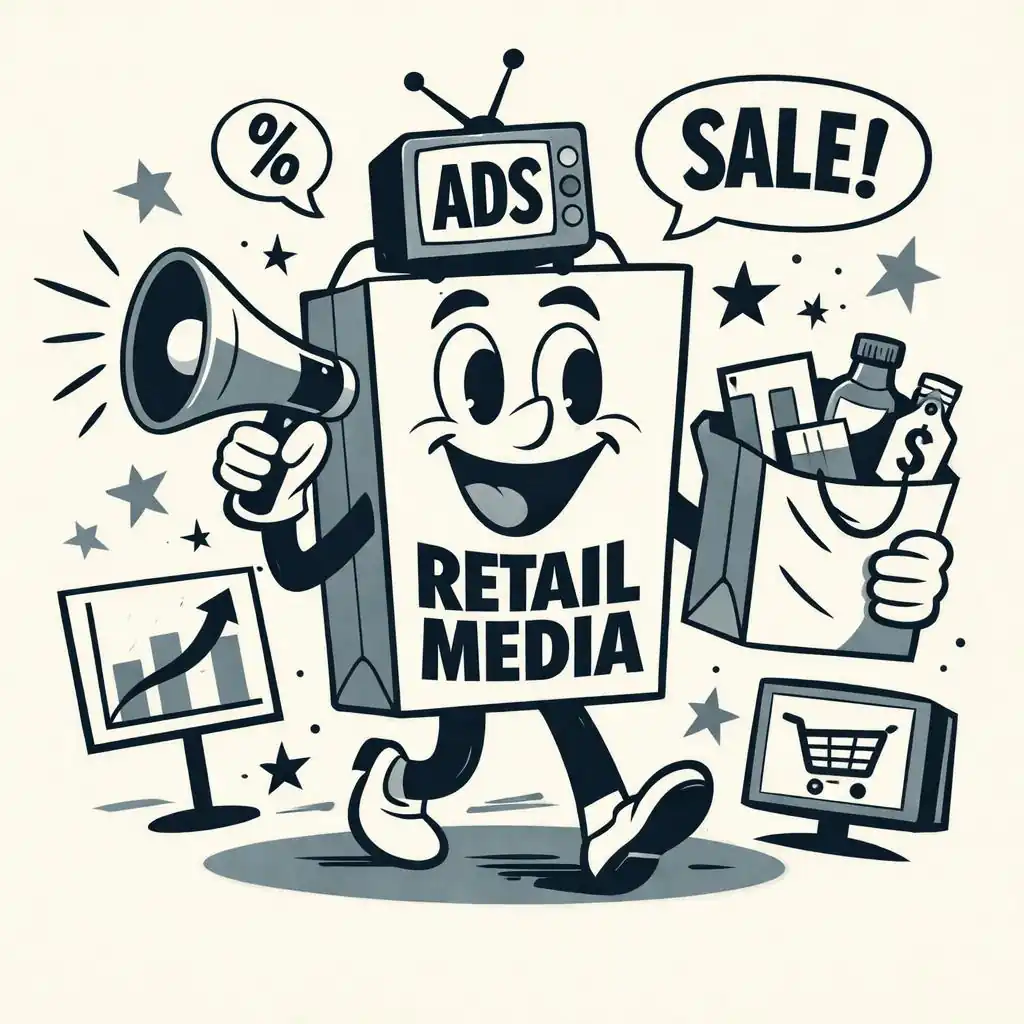
2. Retail Media Networks Are Eating the Advertising Budget
If there’s one channel that defines the advertising trends 2026 reshaping budget allocation, it’s retail media. According to Dentsu, retail media is the fastest-growing digital advertising channel at 14.1% year-over-year growth, ahead of online video at 11.5% and social at 11.4%. WARC projects retail media ad investment will climb to $196.7 billion by 2026, representing 16% of all ad spending worldwide, as reported by Inside Radio.
The reason is straightforward: in a world where third-party cookies are disappearing and privacy regulations are tightening, retailers like Amazon, Walmart, and Target sit on massive troves of first-party purchase data. Advertising against that data delivers measurable, closed-loop attribution that traditional digital channels increasingly cannot match. As Inside Radio reported, retail media spending is forecast to overtake the combined total of linear and connected TV advertising by 2026.
For small and mid-sized businesses, this means that advertising on platforms like Amazon Ads, Walmart Connect, and Instacart Ads is no longer optional — it’s where a growing share of consumer discovery and purchase decisions are happening.
3. First-Party Data Is Now a Survival Requirement
The final phase of third-party cookie deprecation, combined with new regulations like the California Privacy Protection Agency rules effective January 1, 2026, has made the shift to first-party data irreversible. According to AdCellerant’s analysis of 2026 digital marketing trends, 76% of consumers say they won’t buy from a company they don’t trust with their data — making data ownership not just a compliance issue but a competitive advantage.
The Quad marketing predictions report reinforced this, noting that resilient first-party data is becoming a non-negotiable foundation for effective advertising. Brands that have invested in building direct customer relationships — through email lists, loyalty programs, app usage, and consent-driven data collection — are now positioned to outperform competitors still relying on third-party audience targeting.
This shift also fuels the retail media boom: retailers own first-party purchase data by default, which is why advertisers are redirecting budgets toward platforms where the data is strongest. For businesses of every size, the message is clear — if you don’t own your audience relationship, someone else will monetize it.
4. Short-Form Video and Connected TV Are Where Attention Lives
Two video formats are dominating the advertising trends 2026 conversation. On the short end, TikTok, Instagram Reels, YouTube Shorts, and Snapchat Spotlight continue to drive the largest share of consumer attention. As Social Media Today noted, short-form video has emerged as the key driver of attention over the past two years, with engagement metrics that consistently outperform static and long-form content.
On the other end of the spectrum, connected TV (CTV) advertising is surging. According to PwC’s Global Entertainment & Media Outlook, CTV advertising is projected to reach $27.7 billion by 2026, driven by the expansion of ad-supported streaming tiers from Netflix, Disney+, Amazon Prime Video, and others. PPC Chief reported that CTV ad growth is running at 13.8% year-over-year, making it one of the fastest-growing channels in digital advertising.
The practical takeaway: if your advertising strategy doesn’t include a short-form video component for social discovery and a CTV component for streaming audiences, you’re missing the two formats where consumer time is actually growing.
5. AI Agents Are Changing How Consumers Discover Products
One of the most forward-looking advertising trends 2026 is the emergence of AI agents as intermediaries in consumer purchase decisions. According to Gartner’s 2026 marketing predictions, AI agents will take over many routine customer engagements — from notifications to reorders to personalized product guidance — shifting marketing from channel-based execution to autonomous, agent-driven journeys. However, Gartner also cautioned that even AI-enthusiastic consumers hesitate to let digital agents make autonomous purchase decisions, meaning the revenue impact will build gradually.
This shift has a practical implication that Lippincott’s trends analysis identified: brands will need to build “authority-first marketing” — creating a rich ecosystem of authoritative content that AI agents recognize as credible sources of truth. It’s no longer enough to optimize for human eyeballs on a search results page. You also need to be the brand that an AI shopping assistant recommends when a consumer says “find me the best option.”
As Google’s 2026 digital marketing predictions noted, the goal for brands is no longer to bid on specific keywords for a single narrow campaign, but to supply AI-powered search with a library of high-quality assets that can be adapted to match any consumer query.

6. Authenticity Beats Polish — The Human Premium
Perhaps the most counterintuitive of the advertising trends 2026 is this: as AI gets better at producing slick, professional content, consumers are increasingly gravitating toward content that feels unmistakably human. The Quad predictions report noted that in 2026, marketing authenticity will show up through lived storytelling, cultural truth, and creator or employee voices that can’t be replicated by algorithms.
Adobe’s Creative Trends Report found that Gen Z in particular is craving what’s real and what’s local — real textures, real people, real stories. Audiences are embracing the messy, the tactile, and the analog as a counterweight to the flood of AI-generated content. The brands that lean into this — partnering with micro-influencers, showcasing behind-the-scenes content, featuring employee voices, and investing in community-driven storytelling — will build trust that no algorithm can manufacture.
This also explains the continued rise of micro-influencer marketing. As Quad noted, micro-influencers are gaining even greater influence in 2026, offering relevance and relatability at a time when AI-generated content is becoming more common. Their human credibility helps brands maintain trust and differentiate in an increasingly automated landscape.
The bottom line across all six of these advertising trends 2026: the technology is getting smarter, the channels are multiplying, and the budgets are growing. But the businesses that win won’t be the ones with the biggest spend — they’ll be the ones that combine AI-powered efficiency with genuinely human connection. The trillion-dollar advertising market rewards both.
Sources Referenced in This Article
- Dentsu — Global Ad Spend Forecasts 2026
- Statista — Digital Advertising Spending Worldwide
- PPC Chief — Digital Advertising Spend Statistics 2026
- Smartly — 2026 Digital Advertising Trends Report
- Adobe — Four Creative Trends That Will Define Marketing in 2026
- Inside Radio / WARC — Global Retail Media Ad Market
- AdCellerant — 5 Digital Marketing Trends to Master in 2026
- Quad — 27 Marketing Trends and Predictions for 2026
- Social Media Today — 7 Digital Marketing Trends for 2026
- PwC — Changes in Digital Advertising Spend
- Gartner — The Future of Marketing: 5 Trends for 2026
- Lippincott — 12 Trends Set to Define 2026
- Google — Top Digital Marketing Trends and Predictions for 2026
Cleverly Genius Monitors AI
At Cleverly Genius LLC, we don’t just watch the advertising landscape shift — we help our clients move with it. Our team continuously monitors emerging trends in digital advertising, from AI-powered creative production and retail media networks to first-party data strategies and short-form video, so you don’t have to. Whether you need help building a smarter ad strategy, implementing the right tools, or adapting your digital presence to meet consumers where they actually are, Cleverly Genius provides the consultation and development services that turn industry trends into real business results.
Not a client yet? Click Here.